

You were probably told migraine looks like one thing.
You imagine being in a dark room with an ice pack and the absolute worst headache of your life. So when your experience doesn't match — the dizziness with no head pain, the day you lost to fog with nothing to show for it, the exhaustion that shows up a full day later — you second-guess whether this is even what you have.
You Might Feel More Like This:
Dizziness or vertigo, with no headache at all
A full day lost to fog, with nothing to physically show for it
Exhaustion that shows up a full day after the pain is gone
Stomach pain and nausea, especially in kids, with little to no head pain
Temporary weakness on one side of the body, alarming enough to look like something else entirely
“Diagnosed at 34”, “still working full-time”, “still making school pick-up every day” — these are real patterns I see every day in my office. Migraine is a shapeshifter, and most of what gets taught about it is less common version. But your experience is no less valid.
What is Migraine?
Migraine is a neurological disease — a chronic condition of the nervous system marked by recurring attacks that typically involve head pain along with other symptoms like nausea, and sensitivity to light, sound, or smell. Between attacks, the underlying condition is still there, even when you're not in pain — which is why you can do everything "right" and still have one, and why one single trigger is rarely the real explanation. But a definition like this one can seem limited, especially to someone who is looking to understnad migraine.
Migraine is also influenced by genetics. If a parent has it, the likelihood of their kids carrying that same wiring goes up — but carrying the wiring doesn't guarantee attacks. What sits on top of the genes (sleep, stress, hormones, blood sugar, overall brain health) decides if someone actually get migraine attacks, or not.
Between attacks, a migraine nervous system tends to register ordinary input — light, sound, smell, even a shift in the weather — more intensely than a non-migraine nervous system does. It's a real, physical difference in how the nervous system allocates its resources, and what appens when your bodies’ demand exceeds it’s resources. It’s also what is known as a spectrum disorder. Each person with migraine experiences a unique constellation of symptoms. and two people’s migraine experience can vary wildly.
This basic definition fails to explain how migraine gets started, what is happening in your brain and nervous system during an attack, and what you can do to change how your migraine pattern is presenting.
For people who get aura, a slow wave of electrical activity moves across the surface of the brain — about 2 to 3 millimeters a minute. Wherever it passes, that region glitches for a few minutes: shimmering lines if it crosses the visual cortex, a lost word if it crosses a language area. That wave then activates the trigeminal nerve, which floods the blood vessels around the brain with inflammatory signals. That inflammation is where the pain actually comes from — which is part of why it so often throbs in time with your pulse.
The Four Phases
Migraine isn't just the headache — it unfolds in up to four phases, and most people have only ever heard of one of them.

Think of it like a storm rolling through. The sky starts changing hours before the first drop — that's prodrome. For some people, the wind picks up and lightning flashes before the rain even starts — that's aura. Then the storm itself hits — the headache. And after it passes, the ground stays soaked and the air feels heavy for a while longer — that's postdrome. Different migraines are different storms, but most people who live with it recognize this same shape: building, peaking, and slowly clearing, not just one sudden downpour.
Prodrome — hours to a day before the pain, your body is already signaling: food cravings, yawning, neck stiffness, an uncharacteristic short temper, a general "something's off" feeling
Aura — not everyone gets this one. Visual static, tingling, or trouble finding words, driven by that electrical wave
Headache — the phase everyone knows, though it doesn't have to be severe, and for some people it never shows up at all
Postdrome — the "migraine hangover": fatigue, fog, and a depleted feeling that can last a full day after the pain is gone
The Spectrum
Migraine isn't one experience with a dial from mild to severe — it's a spectrum of distinct presentations, and most of the common ones don't look like the stereotype at all.
Silent migraine — every phase, all the disruption, no headache
Vestibular migraine — dizziness or vertigo as the main event
Hemiplegic migraine — temporary one-sided weakness, rare and alarming enough to be mistaken for stroke
Menstrual migraine — tightly tied to hormonal shifts, often more severe than migraine at other points in the cycle
Abdominal migraine — stomach pain and nausea with little to no headache, most common in kids
Chronic vs. episodic — a frequency distinction (15+ headache days a month vs. fewer) that shapes both diagnosis and treatment
If none of the classic descriptions have ever quite matched your experience, that isn't evidence you don't have migraine. It may mean you've been living one of its many forms all along.
I don't believe you need to overhaul your life to get your migraines under control.I believe the plan has to fit inside the life you already have, or it won't survive contact with a real week.
I don't believe in one-size-fits-all protocols. I believe in teaching you to see your own pattern — the one only you have enough data to notice.
I don't believe your body is broken. I believe you've been putting yourself last for good reasons, and migraine is just where it's showing up first.
The Idea Behind Everything Here
Focus On Your Threshold, Not Your triggers.
This is especially useful if you're in the stretch between appointments — raising your threshold doesn't require a prescription pad.
Almost everything else you've read probably tells you to find your triggers and avoid them.
Here's what changed my whole approach: migraine isn't usually caused by one trigger. It happens when everything you're carrying stacks up past a threshold your nervous system can't compensate for. If you can increase the resilience of your nervous system, then migraine attacks have less of a chance to build momentum.
Raising your threshold is real work, and the process takes some time. In the meantime, you still need something for the days it hasn't caught up to yet.
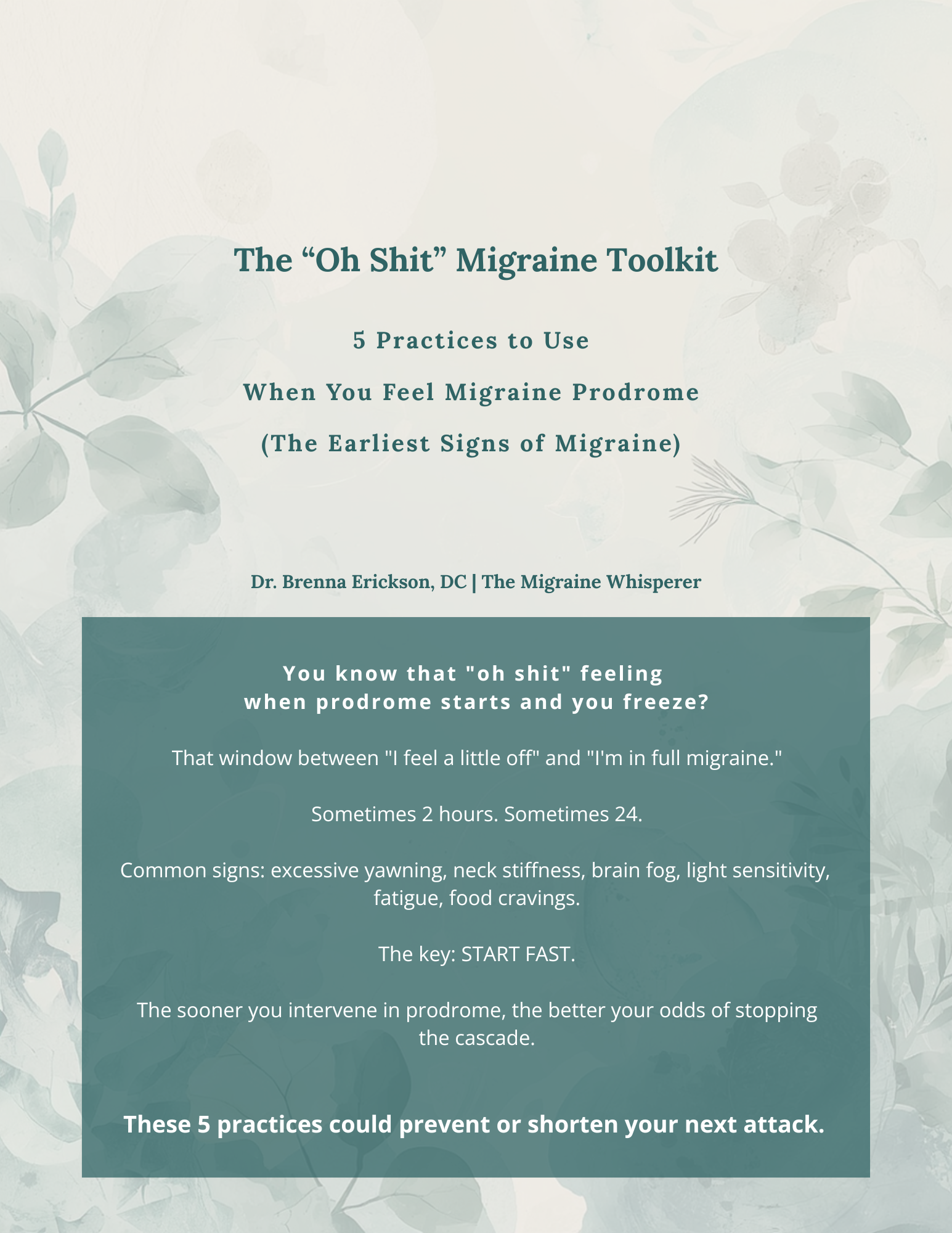
Start Anywhere
Go Deeper On Any Of This
What is migraine, really?
Genetic, but not absolute — a nervous system wiring pattern that daily life determines the volume of.
Start here: Naming It →
Nobody explains what actually happens at a diagnostic appointment.
There's no blood test for this — diagnosis is a clinical process, built on a pattern only you can describe accurately. Here’s what you should bring to this appointment.
Read the full breakdown →

Medication or root cause?
It's not really a choice between two philosophies — they're two different mechanisms.
Go deeper on this →

Your care team doesn't have to happen all at once.
Who to bring in, and when, as your capacity and budget allows — not a dozen appointments starting Monday.
See the full care team guide →


"I joined this group not knowing or realizing the benefits it would bring. I didn’t realize the self-love and tenderness it would allow me to see myself in. I imagined educational content and action steps that might help, but might not fully apply to me. This group has been supportive, helpful, educational and has made a noticable impact on my life."
— MRA participant
Want More?
If this resonates, there's a more complete version of it — six weeks, a small group, built for a life that doesn't have room for one more thing that doesn't work.
Next cohort: September 9th